
Research Interests
From cosmological simulations to large-scale imaging programmes, from visible wavelengths to radio, the overarching goal of my research is to synthesize interdisciplinary data to understand how galaxies evolve over time. I conduct my research at the University of Victoria as a graduate student working with Dr. Sara Ellison.
Resolved Optical + Millimetre Data with KILOGAS
KILOGAS (Kiloparsec Investigations of Local Objects’ Gas And Star-formation) is a large ALMA program aimed at transforming our understanding of the drivers of star formation activity in galaxies. We map CO(2-1) at 1 kpc resolution in a sample of ~500 galaxies, an order of magnitude more than in any existing survey, and crucially representative of the entire local population (in terms of mass, SFR, size, morphology and environment). All galaxies have optical integral field spectroscopy from the MaNGA and SAMI surveys, providing resolution-matched SFR, metallicity, and M* maps, as well as ionized gas and stellar kinematics.
Check out the team website.

SALVAGE-ing the ALMA Archive
The SDSS-ALMA Legacy Value Archival Gas Exploration (SALVAGE) dataset combines optical data products from the Sloan Digital Sky Survey (SDSS) and molecular gas measurements from the Atacama Large (sub-)Millimeter Array (ALMA) archive to produce a sample of 277 “semi-resolved” galaxies.
The data is publicly available here. 
Cosmological Simulations
I generally interface with the IllustrisTNG cosmological simulation for the purpose of generating synthetic images of galaxies with realistic properties and environments.
Below is an example of one IllustrisTNG100-1 post-merger galaxy simulated at 36 different image qualities from my most recent paper. The data used to generate this image is publicly available and can be found here.
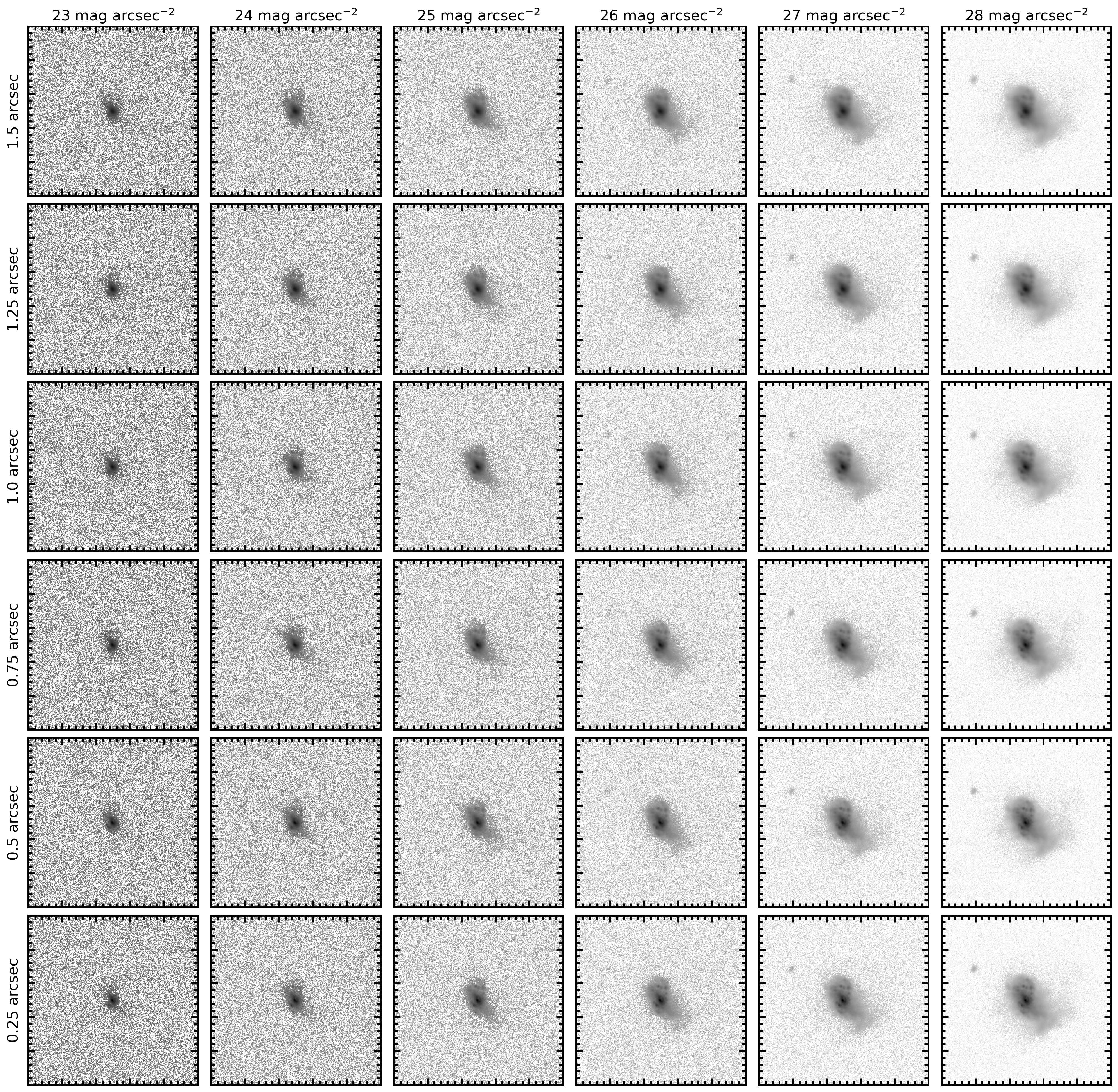
Our group at UVic often uses synthetic images like these to train machine learning algorithms to detect interacting galaxies. See Bickley et al. (2021).
Post-starburst Galaxies
Post-starburst galaxies are characterized by having undergone a recent burst of star-formation, followed by a rapid transition to quiescence. Post-starbursts are therefore an integral probe of rapid quenching and the cessation of star-formation.
While galaxy mergers have long been suspected to be a driving cause of post-starburst galaxies and rapid quenching, many studies over the past several decades have disagreed on the fraction of post-starburst galaxies that have been induced by a recent merger. Wilkinson et al. (2022) revisits this idea, and certainly answers why there’s disagreement in the literature.
In Ellison et al. (2022), we show recent mergers are 30-60x more likely to be a post-starburst galaxy than a typical galaxy.
Large-scale Optical Imaging Programmes
I am an active member of the Ultraviolet Near Infrared Optical Northern Survey (UNIONS) collaboration. UNIONS offers deep and (relatively) high resolution imaging of the Northern sky, facilitated by the Canada France Hawaii Telescope, among others.

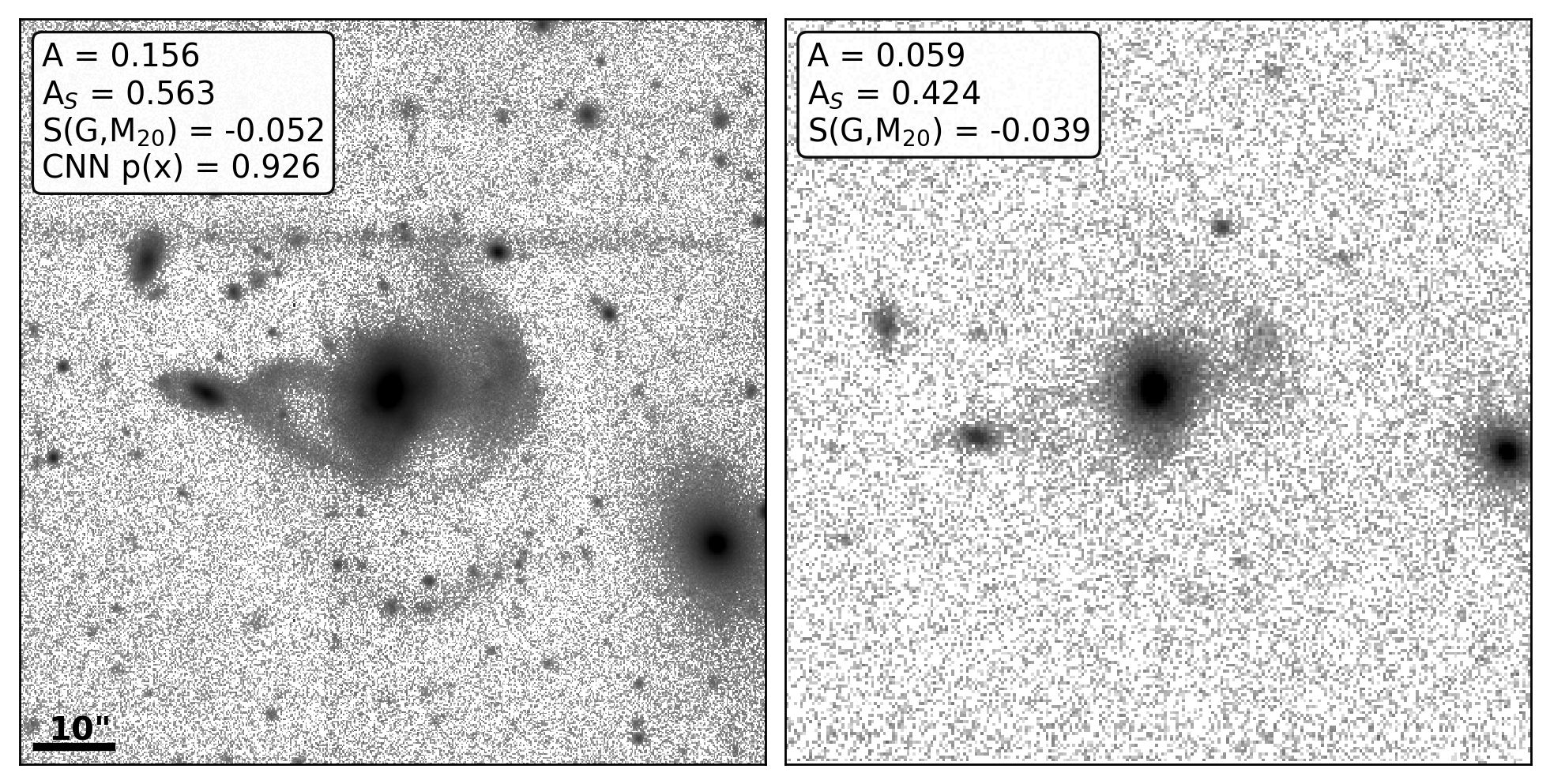
Here is a comparison of a UNIONS (left) and an SDSS (right) image of the same post-starburst galaxy, with relevant non-parametric morphology statistics for post-merger identification labelled.
Quantitative Galaxy Morphologies
I have statmorph morphology catalogues prepared for the ~200,000 galaxies in UNIONS that also fall in the SDSS DR7 main galaxy catalogue (and thus have ancillary data products such as star formation rates and stellar masses).
I also have the morphology catalogues of entirety of SDSS DR7 in both the g- and r-band.
These data are available upon request.